Selasa, 14 Juli 2015

Golden Crest (Lophiola aurea) - Coastal Plain Endemic with strange "disjunct" distribution

Lophiola aurea, Brunswick Co, North Carolina
June 3, 2015


Golden-Crest (Lophiola aurea) is endangered in North Carolina where it is known from only a handful of sites in the extreme southeastern coastal plain. The species is entirely absent from adjacent states of South Carolina and Virginia but populations reappear both further north and south, The nearest populations to the south occur in south-central Georgia, a disjunction of approximately 440 miles!  From there, Lophiola's known distribution (based on USDA PLANTS database) skips over another approximately 140 miles before re-appearing in the panhandle of Florida (where it seems to be most widespread), and adjacent Alabama and southern Mississippi. Interestingly, another widely disjunct population has been reported in western Louisiana. To the north, the species re-appears in New Jersey and a few points beyond including Nova Scotia!  These northern populations may be the most unexpected.  To quote G.E. Nichols (Rhodora 1919), "Lophiola aurea in Nova Scotia. Surely there must be a mistake".  But no mistake...it occurs there along with a number of other disjunct populations of typically southeastern US coastal plain species.

Lophiola aurea population in Brunswick Co, NC
(dark shadow on left is dense woods)

Back in North Carolina, the small population shown here (left) was holding on at the very edge of a power-line clearing. Maintenance activities and off-road vehicles had torn up much of the adjacent ground while the surrounding woods appeared to be too dense and overgrown (unburned) to support the plant.

Last summer I observed Lophiola in all its glory in an open pine savanna in north Florida. It's almost embarrassing how much time I spent watching small bees visit the tiny (~ 10mm wide) flowers. Since I did, I'll include a few images here:
Lophiola aurea pollinator, south of Tallahassee Florida
July 5, 2014


I'd be interested to know what species this little bee is, and whether or not it occurs throughout Lophiola's highly fragmented range.

Minggu, 12 Juli 2015

let's start with exciting news...


Let's start with exciting news

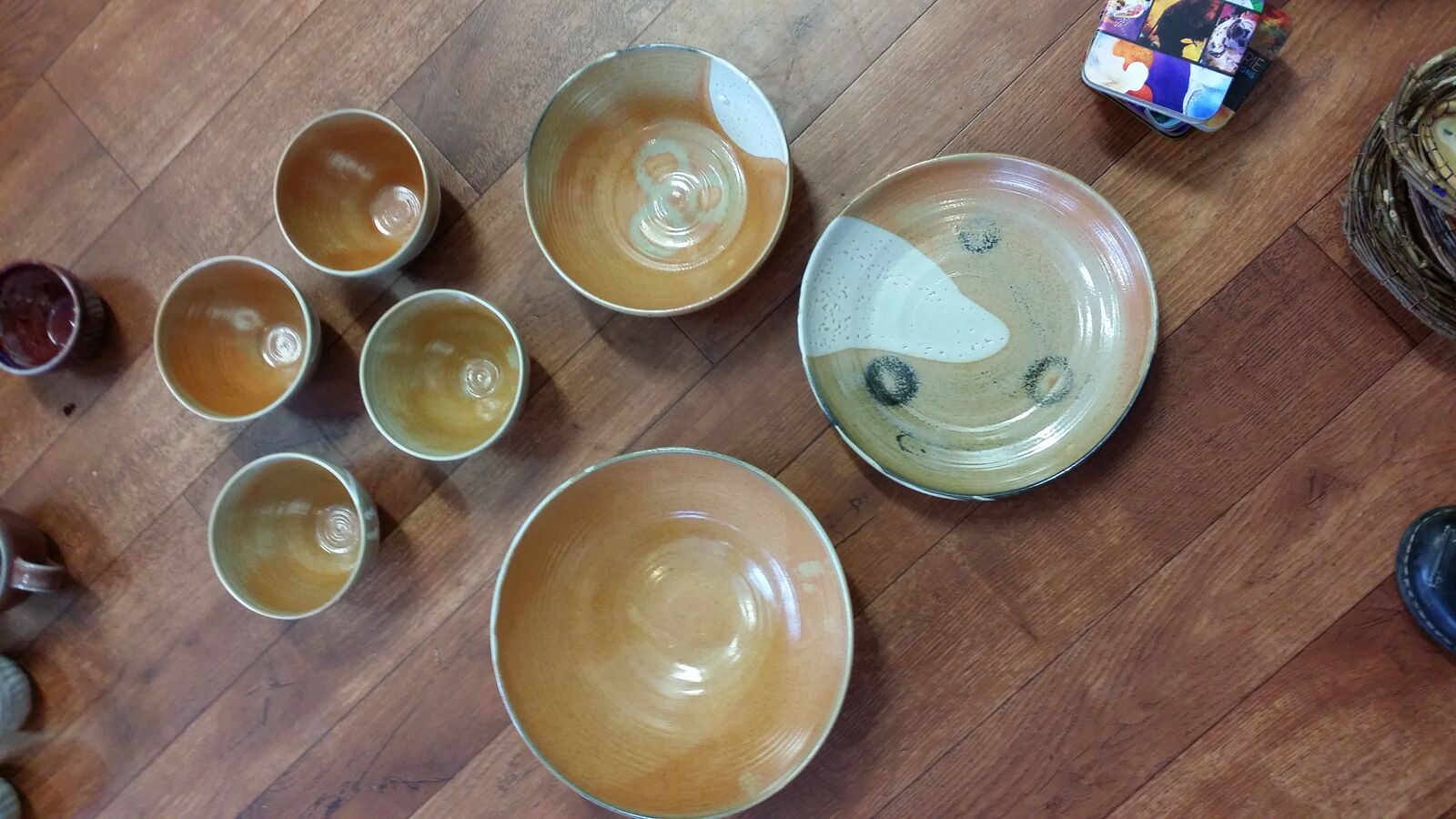
I'm in the process of moving studio to the barossa!
having said that eeeek!!!

It's quite the change moving to The Jam Factory studio space at Seppeltsfield but it will be fabulous for workshops etc. Yep what you see above is where i'll be as of next week when all of the crates and ladders etc will be gone and we'll get some cleaning happening ;)

There's a couple of trusty kilns that need setting up and I'm waiting to see what happens re gas but it's a beauty of a solid brick kiln, wait til I get my hands on that ;)


and new 'fangled controllers' on which is mostly a manual kiln, yey!!


And an interlude of 'Mugs Day' at Milan Rouge CCD Stirling again this winter, unfortunately virus number 3 this season had me knocked out unable to make it but I hear it was a blast!


Also moving Studio Sale day at mine, was rather fabulous seeing so many old and new friends turning out this year. Thank you all for a fab day and hope to see you out at my new location. 
Let's get together and christen the new studio soon!


On to SALA works, held up again by the darned lung infection #2 my Sala efforts were delayed  and only got into the studio last wkd. Lucky for me the sun was shining and a great making / developing 3D tile works time was had. The practical side of developing new ideas takes quite the concentrated effort and finally by day #8 they are made, slipped, decoed and drying…The new processes are now stored for post firing analysis, what worked and what didn't. I've saved the pattern pieces and quite like the 'brick' forms that have resulted from this style of construction…
Thanks so much to Kevin's monster roller! better than a slab roller and my arms survived the workout ;)


At this point on saturday I brought everything inside as no way  was any drying going to happen in this weather. The hail came down along with the occasional downpour of the wet stuff! It snowed at Mt Lofty, usually an indicator of the coldest day in winter but we're not high enough for any retention of the white stuff, aside from the hail which hung around for ages here! Well the wares are drying nicely inside, I have a bisque kiln on firing Kevin's works for the pit firing, which means the kiln will be nice and warm for my loading works tomorrow. Anyhoo that's about it for news, no doubt posting from Seppeltsfield soon...


Oh Dread! Another Naturalized Exotic Plant?


Driving down the highway along the Northeast Cape Fear River near Wilmington recently, I caught a glimpse of the plants shown above.  The 5-6' tall plants with bright yellow flowers were unfamiliar so I risked life and limb and pulled a U-turn on the heavily traveled road to take a closer look.

Ludwigia bonariensis, near Eagle Island, NC
July 7, 2014


The plants were incredibly attractive and intriguing.  I concluded they were most likely Ludwigia bonariensis.  I was excited by the comment in the Manual of Vascular Flora of the Carolinas which listed it as "very local; Brunswick and New Hanover cos." --- this thing was rare!

But then I got confused!

A later check of Godfrey & Wooten (Aquatic & Wetland Plants of the Southeastern United States) listed it as  "Local, s.e. N.C.; Fla." but added, "native of Trop. Am." --- this thing was exotic!

Weakley's Flora stated it is "apparently native of tropical America" and suggested it may have been introduced on ship's ballast, while noting our plants appear to differ somewhat from specimens elsewhere.

NatureServe considers it exotic in NC, SC, and AL, but lists it as "critically imperiled" in Arkansas. Also of interest is the common name used by NatureServe; "Carolina Seedbox" - an odd name for something from the tropics.

USDA Plants lists it as native in NC, SC, AL, and FL and doesn't record it all from Arkansas.

Both USDA Plants and NatureServe omit the record that showed up in an artificially created wetland in VA around 10 years ago....

My head is humming and it won't go - in case you don't know.....


Ludwigia bonariensis sepals and capsules, just west of Wilmington, NC

IF ANYONE CAN SHED LIGHT ON EITHER THE TAXONOMY OR NATIVE DISTRIBUTION OF THIS SPECIES IT WOULD BE APPRECIATED!


Senin, 29 Juni 2015

An untouched ecosystem?


As an ecologist, I have always contemplated the question of “Is there an ecosystem that is untouched by mankind?”

 And before I started to do research on Hog Island, VA, I would have answered that question with a resounding “there has to be some nook, cranny, or remote area that remains unaffected.” Now I’m not convinced.

Hog Island, VA is a barrier island off the Atlantic coast of the Delmarva Peninsula that has not been inhabited by humans for quite some time now. So, you might expect that if you visited such a place that you wouldn’t find much evidence of mankind. However, this notion would be wrong.

Map of the Eastern Shore of Virginia
 
 
Aerial photo of Hog Island looking north
As soon as you step foot on this island, it is obvious that as humans we impact all ecosystems, inhabited or not. How this particular ecosystem is impacted by humans is though what I call “sea trash,” which is essentially litter that washes up onto the island.
The amount of sea trash that has washed up over the years on Hog Island is astounding. Anywhere you walk on the island, besides the active beach zone, is pretty much sprinkled with litter. There are your typical plastic bottles from water to Gatorade, there are also your miscellaneously colored glass bottles which most likely previously housed some form of hooch, but there are also things that you might not expect.
The first thing that shocked me were the amount of lightbulbs. THEY ARE EVERYWHERE. From the long four footers that produce the horrible fluorescent lighting in office buildings, to the typical 60 watt bulbs that people use to use in their homes before everyone shifted to the eco-friendly CFL bulbs (you know, the ones that look like a vanilla ice-cream cone swirl), they are all there. It is nothing to be walking through the island interior, which is composed of both grassland and shrub communities, and hear a distinct crunch underfoot knowing good and well that you just accidentally stepped on a lightbulb. The only thing you can do is keep on trekking and try to avoid the next one.
 
Grassland and shrubland communities on Hog Island
The other surprising set of items that seem to wash up fairly regularly are car maintenance items. Air filters are particularly common, as well as oil filters, car oil bottles and antifreeze bottles. Even uninhabited islands can’t seem to escape industrialized, automotive driven America.
Since I visit Hog Island fairly frequently, I have become accustom to the ends and outs of variety of sea trash that washes up, but every now and then you get some particularly interesting items such as old thick televisions half buried in sand, Jumbo LEGO building blocks (yes, even on a remote island your feet are not safe from these monsters), fully inflated beach balls, deflated balloons of all sorts, from Happy Birthday! to Get Well Soon, and buckets galore! Nice buckets too, I’ve even taken a few particularly nice ones home with me!
All of this sea trash however sheds light on another problem that people may not often think about, the cleanliness of our oceans. It is a scary thought that what I see washed up on this island is just a microscopic fraction of what is floating around out there. And with the amount of coastline the world has, it is hard to think of an ecosystem that wouldn’t be impacted by the copious amount of trash floating in our oceans. If you think about it, even Antarctica, one of the most isolated places in the world, has a coastline that could be impacted by sea trash.
This thought and my personal experience on Hog Island is what has firmly solidified my belief that no ecosystem is truly untouched by mankind.
By: April Harris
 

Minggu, 28 Juni 2015

GONE VACATIONING: Anything Ordered From July 1st through July13th Wont Be Shipped Until July 14th &15th

GONE VACATIONING: 
Anything Ordered From July 1st through July 13th 
Wont Be Shipped Until July 14th &15th


Any orders placed July 1st through July 13th: 
Seeds, Neem Oil, Calcium Nitrate 
wont be shipped until July 14th & 15th.

Good Luck with Your Garden,
Gary (The Rusted Garden)

Join My New YouTube Channel Just for NEW Gardeners: My First Vegetable Garden

Join My Google+ Community Our Tomato and Vegetable Gardens (5000+ Members!)
400+ HD Short and to Point Garden Videos: My YouTube Video Gardening Channel
Follow and Organize The Rusted Garden on Pinterest

Rabu, 24 Juni 2015

Rabu, 10 Juni 2015

Why & How to Bottom Prune Tomato Plants: Airflow, Splash Barrier, Decrease Diseases


My Most Recently Published Video.


Good Luck with Your Garden,Gary (The Rusted Garden)


Join My New YouTube Channel Just for NEW Gardeners: My First Vegetable Garden

Join My Google+ Community Our Tomato and Vegetable Gardens (5000+ Members!)
400+ HD Short and to Point Garden Videos: My YouTube Video Gardening Channel
Follow and Organize The Rusted Garden on Pinterest

Popular Posts

Recent Posts

Categories

Unordered List

Text Widget

Pages

Diberdayakan oleh Blogger.